Breaking Bad 101
The Complete Critical Companion
The ultimate guide to the greatest show on television. Deep analysis, behind-the-scenes secrets, and exclusive insights.



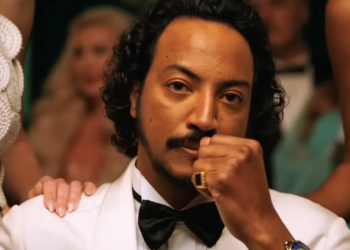
Pluribus has prompted intense theorizing about character motives and alignment, and one of the most persistent hypotheses concerns Koumba’s apparent defection in a Las Vegas‑style sequence. The series frames such developments within its broader inquiry into social engineering and institutional cooptation. Viewers and critics have noticed that scenes of ostensible leisure often carry documentary‑like cues that suggest strategic assimilation rather than simple escape.

The sequence in which Koumba appears to be “living the dream” is staged with particular visual economy: saturated nightlife lighting, close framing on branded spaces, and recurring shots of synchronized behavior. These production choices juxtapose surface pleasure with underlying uniformity, inviting readings that the environment functions as an instrument of alignment. The show’s camera lingers on ritualized gestures and public signage in ways that convert ambiance into evidentiary detail.
Placement within the season’s arc is also significant. The Vegas sequence follows several scenes that emphasize organizational outreach and the normalization of new rituals—registration booths, community chants, and sanctioned leisure events. The cumulative context suggests that Koumba’s apparent comfort may be structured by the same institutional logics depicted earlier, rather than representing genuine autonomy. Fans have pointed to the editing rhythm and the recurrence of administrative artifacts as signals that assimilation is both procedural and designed.

Performance detail is central to assessing whether Koumba has been compromised. The series foregrounds micro‑behaviors—hesitant smiles, patterned responses, and calibrated timing—that have been used elsewhere to indicate alignment. In the Vegas scenes, certain gestures are repeated in group settings and later replayed in different contexts, which can be read as markers of conditioned response. The show’s emphasis on repetition supports the interpretation that these behaviors are symptomatic of a broader synchronizing mechanism.
However, the narrative also preserves ambiguity about agency: characters who appear complicit often exhibit moments of hesitation or equivocal expression that complicate straightforward readings. The series consistently resists reducing choice to binary categories, and Koumba’s arc is constructed to allow both readings—willing participation or covert endurance. This narrative strategy forces viewers to scrutinize outward behavior against the administrative backdrop that produces it.

Beyond individual behavior, the plausibility of compromise depends on institutional dynamics. Pluribus recurrently depicts incentives—access to resources, social status, and protection—that make assimilation strategically rational for some actors. The Las Vegas scenario, with its visible provision of comfort and spectacle, functions as a case study in how governance can purchase compliance by converting scarcity into selective abundance. This political economy explains why characters might accept alignment even if it enforces limits on autonomy.
Moreover, the series suggests that institutions use ritual and spectacle to reconfigure consent by embedding normative behavior within pleasurable contexts. The coupling of entertainment and administration—branded events paired with registration drives—is presented as a mechanism for normalizing new practices. In that light, Koumba’s apparent acquiescence would be less an indictment of individual character than a demonstration of how systemic design produces predictable social outcomes.
Interpretive caution is warranted: the show deliberately foreshortens explanatory arcs to preserve ethical ambiguity. Direct evidence of conscious betrayal or permanent compromise is withheld, and the narrative rewards careful attention to documentary artifacts and cross‑episodic repetition. Viewers parsing Koumba’s trajectory must therefore weigh visual cues, behavioral micro‑signals, and the political logic of institutions together rather than relying on a single moment of apparent leisure.
In closing, the question of whether Koumba is secretly joined or compromised in Pluribus is best answered through an integrative reading that considers cinematic signals, performative detail, and institutional incentives. The series constructs assimilation as both seductive and procedural, making the Vegas sequence a compelling test case for the program’s broader argument about how authority is produced. Whether the character is fully coopted, strategically compliant, or subtly resisting, the narrative ensures that the stakes remain political: Pluribus equates pleasure with policy and thereby asks viewers to interrogate how social design shapes consent.
Pluribus has emerged as a polarizing entry on Apple TV, prompting debate over whether the series depicts an alien...
Episode 5 of Pluribus, titled “Got Milk,” turns a domestic commodity into a lens on social organization and emergent...
Debate about Pluribus has centered on the nature of the signal that appears to accompany societal alignment, and a...
At PaleyFest NY 2025, creators and cast of Pluribus discussed the show’s development, revealing that a central role was...

© 2025 PLURIBUS SERIES | We are not affiliated with Apple TV+, our content is not official or endorsed by them in any way.